BACK
Why most growth problems are measurement problems in disguise
Most founders I work with have been in the market for a bit. They know their stuff. They have a genuinely capable growth or marketing team and have tried all growth tactics under the sun. They've gotten far and yet, growth still feels like an unpredictable black box.
Maybe you can relate:
You're running ads. Publishing. Testing offers. Maybe a lead magnet, maybe a founder social media account with real reach. The effort is there and it's not obviously misguided. But the growth isn't, or not the way it should be, and nobody on the team can tell you exactly why.
The reflex is to do more. Another channel. New creatives. Push harder on whatever you can see. Ask AI for help and get a list with five more action items back. It rarely moves anything, because you're guessing at which part of the machine is broken. And you can't fix what you haven't found. Here's how I approach it.
First, locate the problem
I joined a B2B company right after a raise. The mandate was to grow 10x in two years. When we looked under the hood, there was nothing to look at. No measurement at all. They had a feel for how many demos they booked and how many prospects they called, but no real numbers.
So we built them. I started by hand, asking the team: how many people did you call, how many demos did that book, how many offers went out. Then I put it into a funnel and modelled it backwards from the 10x goal, so we knew how many outreaches, first calls, demos, and offers each week the target actually required (that work later turned into a proper business case, which I believe every commercial lead in a growing company should own, but that's beyond the point here).
Two things surfaced. Both were invisible before we measured.
First, their felt truth about the process was wrong. They believed they turned around 90% of held demos into offers. The real number was nowhere close. Second, and bigger: their main motion barely worked. They ran on cold outbound. Almost none of their customers had come from it. The ones who signed came through founder-led channels, events, and network. They had been pouring their energy into the one motion that wasn't producing revenue.
That is what measuring the full funnel is for. Not because dashboards are nice. Because without one, you optimise what's visible or familiar, not what's actually holding you back.
Another company I worked with put a lot of effort into their top of funnel marketing: Ads on Meta and Google, a founder with 30,000 followers on LinkedIn, lead magnets with impressive sign-up rates. And yet, the company barely generated meaningful leads outside of referrals. And they didn't really know why, because analysis and measurements were one-off and ad-hoc efforts, not a recurring notion. So they followed anecdotal hunches on where to focus but without real clarity, efforts just got more scattered.
It turned out, that top of funnel was not the problem. The company, which runs a long standing and deeply credible B2B service business never clearly stated what they offered and what the benefits were on their website, even though they could very clearly articulate it internally. Yet, the website was the aggregator of all their traffic. The lead magnets that collected email addresses were never followed up with.
All that top-of-funnel work, poured into a bucket with a hole in the middle. They couldn't see the hole, because they weren't looking at it.
That's why I am such a proponent of building out funnel measurements and reviewing them on a weekly basis (best with the whole growth team). It forces an analysis and understanding of one's own numbers to the point where, with time, you'll be able to immediately spot outliers and catch leaks that would otherwise have taken you weeks to identify.
Once you can see the funnel and have a rough benchmark on what good looks like, the weak stage tells you where to look. Here are a few intuitive e-commerce examples:
People click your ads and bounce immediately → Mismatch in expectations from ads to website. Look at the UX from creative to landing page but don't touch e.g. checkout.
Add-to-carts but no purchases → Something likely off in the checkout. Shipping time & cost, payment methods, or missing trust signals. Don't go and spin up 10 new ad creatives.
People buy once but never come back → that's retention, could be a CRM issue but it's usually the product. Go and talk to churned customers to understand more.
Everything above is going well → then your problem is volume. Go get more people on the site.
But how do you actually build such a funnel in practice?
It'll look a bit different for each company, depending on your business model, whether you are B2B or B2C and what channels you're playing in. But here are some specific guidelines.
Most of the time you can structure your funnel on the basis of the pirate or AAARRR funnel, which looks like this:
Awareness → How many people do you reach? See an Ads, get cold called?
Acquisition → How many people land on your website? Agree to an intro call?
Activation → How many people take the first important step? Sign-up? Book a demo?
Revenue → How many people start paying? How much? For how long?
Retention → How many people come back again? In what interval?
Referral → How many people refer others to your business? Through what channel?
Within those, you pick the specific actions that make sense for your business. I recommend doing this on a blank sheet, disregarding what you can actually track in reality with your current setup. Get an ideal funnel on paper. Then figure out how you can get / approximate the number you're looking for.
And then, most importantly, between steps add your conversion rates. Absolute numbers are less important than what percentage of users take the next step. E.g. if 1,000 people saw your IG Ad in any given week and 10 clicked through, that's a Click-through rate (or CTR) of 1%. If you now put more budget and the number jumps to 10,000 the question is, whether the CTR will hold.
I am a big advocate of doing this manually. In Google sheets or whatever works for you. Dashboards in specific channel tools (like Meta Ads, Hubspot, whatever) are great but they'll always force into the limitations of the numbers you have in that tool.
I am even a fan of really doing the weekly manual work of taking 20 minutes, gathering all relevant numbers from the different sources and adding them to a google sheet. That's not optimized at all in the classical sense, but it forces me to spend time with the numbers and immediately put them into relation to last weeks. And if I see something off, I can immediately go investigate in the respective tool that is the source.
Here's an example of what that can look like in practice. Taken from actual client work (recognize the AAARRR structure).
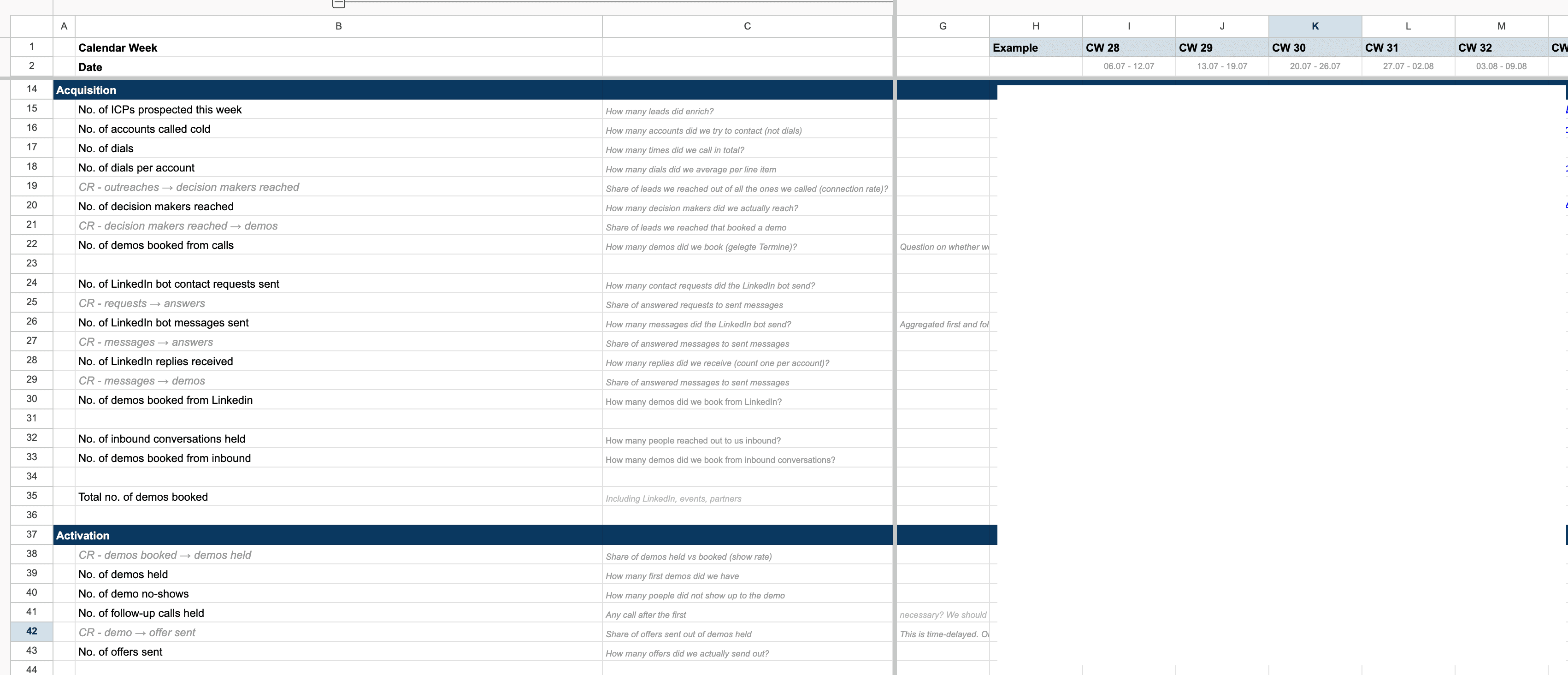
So now we did the hard part. Build the funnel, understand where the problem lies. But now what? In truth, the funnel won't tell you what fixes the weak stage. It won't design the experiment or pick the channel. But it tells you which stage to obsess over. And that alone kills the most common failure I see: a good team improving a stage that could genuinely be better, but isn't the thing in the way.
Then, focus the fix
Locating the stage is where most people stop with the analytical take. It's only half the job. You've gone from the whole funnel down to one stage, and more likely, you still have more ideas for that stage than you can run. If you identified "website" or "demo call" as the problem stage, you still have no qualitative insight into "why" and probably 50 ideas of what could be done differently. So focus has to happen again, one level down.
If you can't get qualitative insight, and are deciding on which fixes to try, diverge on purpose first. Write out every idea for fixing that stage. There are usually many and they are not the same. Fixing the headline copy is not the same as restructuring the homepage. Putting the founder in every demo as a strong closer is not the same as revising the sales deck. So turn your ideas into hypotheses and rank them: how strong of an indication do you have that this will work, how big is the risk if the idea flops, how easy they are to run. Use ICE or RICE if it helps. The framework doesn't matter in detail. Forcing the ranking does, instead of chasing whatever feels most exciting this week.
When I do this with a team, I'm mostly facilitating. They have better estimates than I do for effort and risk. My job is to get the highest-impact test to the top, then keep them honest about it. Every week on the same ranked list. Discipline is what makes this work. Don't abandon the plan and jump to a new idea just because the founder brought it up in a weekly meeting (you can't imagine how often this happens). It goes in the backlog and gets ranked like everything else.
And before you run the test, you decide what success looks like. Beforehand. That habit comes from years spent validating business models, where the whole job was deciding what would kill an idea before running it, so you couldn't argue your way out of the result afterward. It's the step almost everyone skips. But skipping it allows you to later infuse the result with a story that will muddy the verdict.
Here are two examples of what I mean:
I ran a paid acquisition test for a service business once. To validate if google search ads are a reliable way to generate quality leads. We agreed up front: run it two months, then look at revenue actually generated, and decide from that whether the channel earns a place. Two months later, leads were up, but because the tracking setup didn't allow us to attribute them automatically and no one asked in the intro call as agreed, we couldn't attribute any of it. We couldn't answer the question we'd set. It felt like it was working, though, so they kept it running, and quietly became an ongoing thing justified by a story rather than a number.
Another company I worked with set out to build thought leadership through LinkedIn content. The push came through a senior partner, based on the assumption, that the visibility of the companies frameworks and methods would build trust and allow them to charge higher day rates with their customers. It was never defined how and by when we'd evaluate if the outcome was worth the effort. So the team posted. It didn't land. Months later the question came back: how many leads did this content close? Probably zero.
But more importantly, the goal of the test had moved underneath the teams feet. It started as "become known for this" and became "generate leads," which are two different experiments wearing one label. Without success criteria fixed in advance, you leave yourself room to move the goalposts and tell a flattering story later. The criteria are what stop you.
How much of this rigor a team can hold varies, and I calibrate to it. Some founders run on instinct, and a five-point priority list is already as much structure as they want. Others, usually the more product-led ones, want to go deep into the numbers. The two moves underneath don't change: locate before you fix, and decide what counts as success before you run the test.
Closing thoughts
Most growth problems don't stem from a lack of effort. They're just effort pointed in the wrong direction. Measurement tells you the direction to put your effort towards. But only when you apply focus to your solution idea, will you actually start moving. Sometimes I talk to founders that feel that this is a lot of overhead and in turn, the enemy of ambitious growth. To me, it's what turns a busy team into a compounding one.
About the author: Fabian Herrmann is a fractional commercial partner based in Berlin. He co-founded Switzerland's first consumer electronics rental platform, and scaled it to 12,000 contracts and 22 employees as Chief Commercial Officer. He now works with seed to Series A startups building their commercial operating systems from scratch.
More